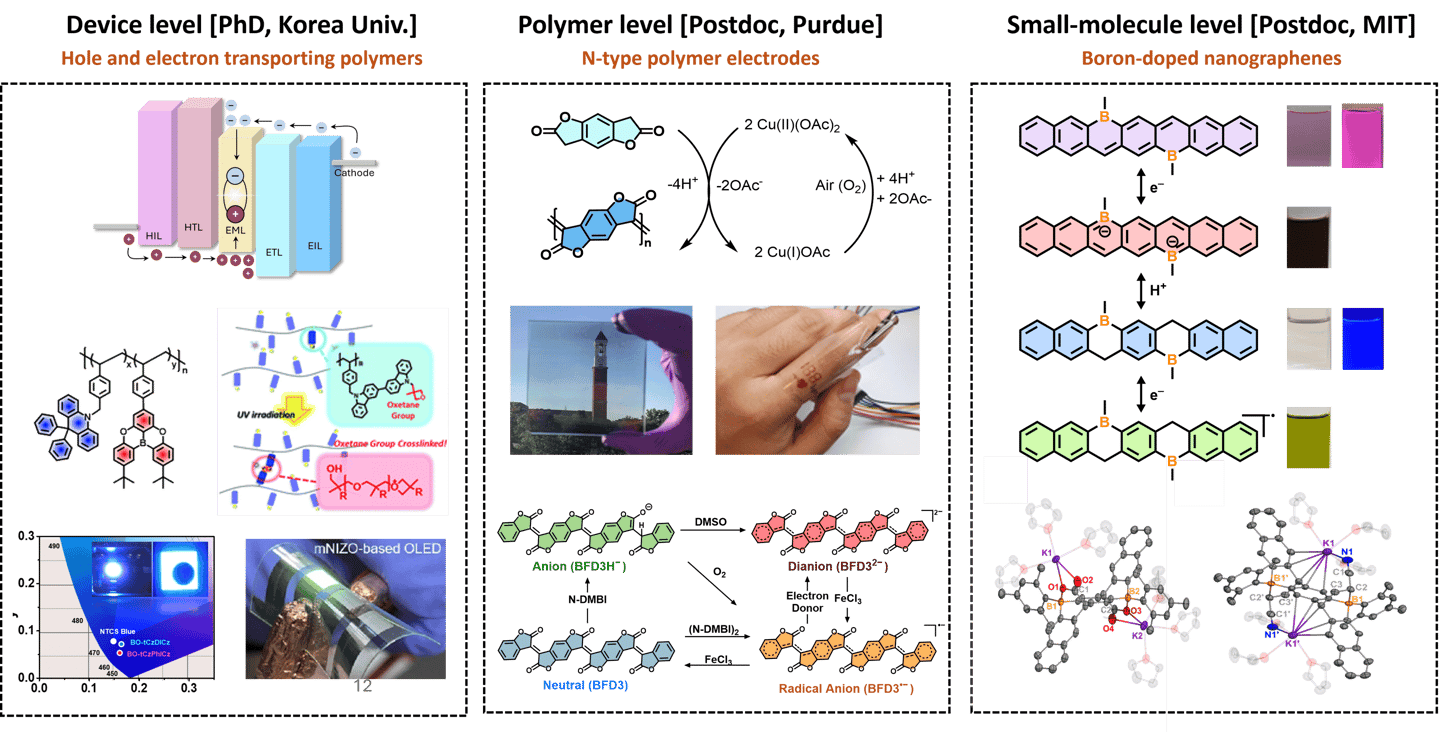
Our research focuses on the development of next generation free-form organic semiconductors. We are interested in exploring conducting polymers, stimuli-responsive materials and device fabrication. Our work-flow combines organic synthesis, polymer engineering, and device application.
Welcome to


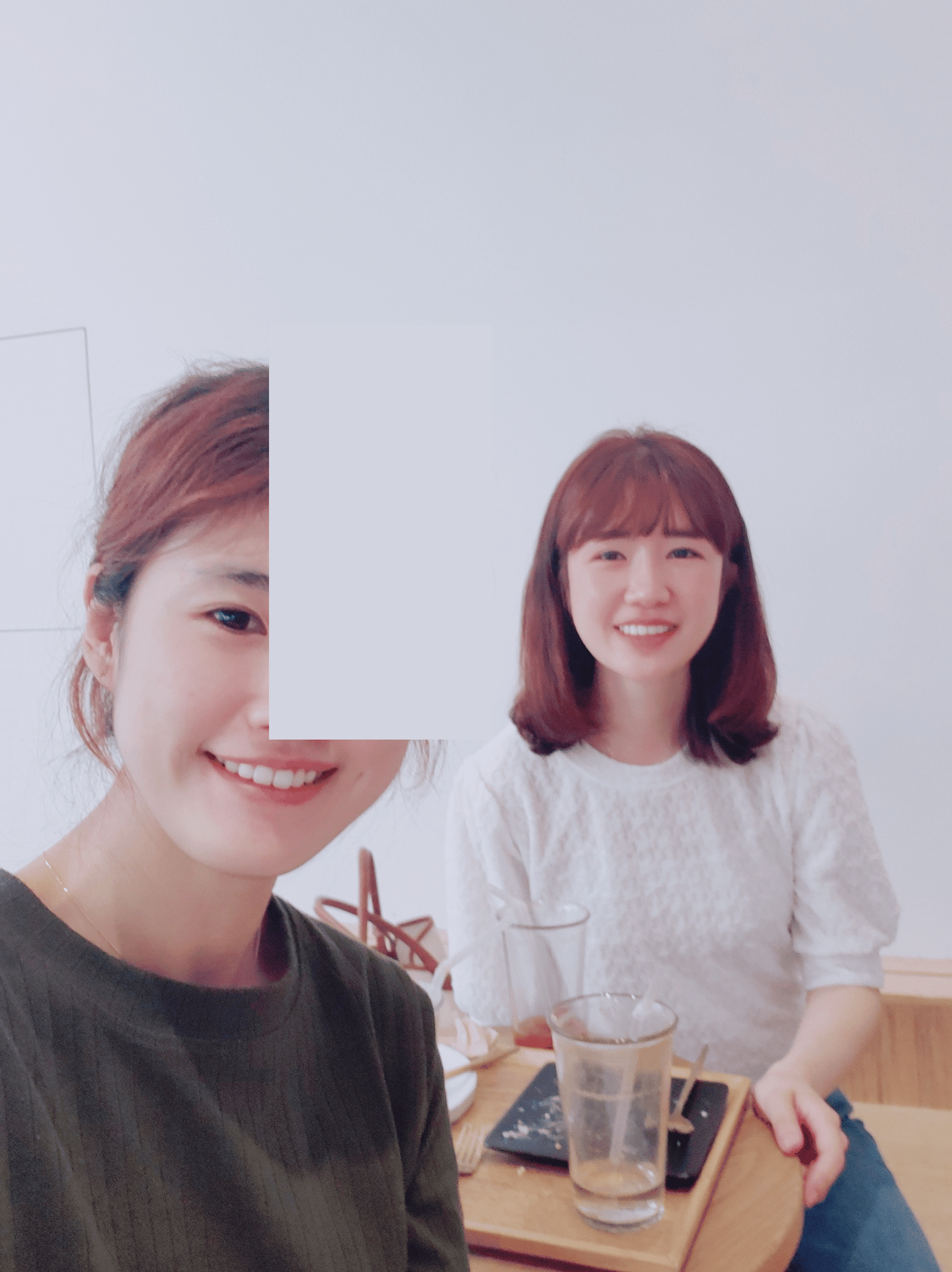
Jiinhyo Hwang, Ph.D
Postdoctoral Fellow at MIT
Hwang Research Group!
Jinhyo Hwang is from Seoul, Korea. She received her PhD in Chemistry in 2022 from Korea University under the supervision of Prof. Dong Hoon Choi. During her PhD studies, she investigated thermally activated delayed fluorescence (TADF) materials for organic light-emitting diodes (OLEDs). Following her PhD, she continued her research as a postdoctoral fellow at Purdue University with Prof. Jianguo Mei, where she expanded her work to transparent conducting polymers. In 2024, Jinhyo joined the Gilliard group at MIT as a National Research Foundation of Korea Postdoctoral Fellow. Her current research focuses on the redox chemistry and small-molecule activation of nanographene under the supervision of Prof. Robert Gilliard.
Next generation organic free-form electronics
Publications (†Both authors equally contributed to this work, *Corresponding author)
[22] Redox- and Protonation Tunable Diboraheptacenes
J. Hwang, H. Kim,† M. Khan, X. Ni, J. Soares, J. E. Barker, M. D. Villarde, J. I. Wu, R. J. Gilliard Jr.*
J. Am. Chem. Soc. 2026, 148, 9754.
[21] Elucidating Charge Carrier Reactivity, Conversion, and Degradation in n-Doped Oligo- and Poly(benzodifurandione)
J. Hwang, X. Ni, M. F. Espenship, K. Tang, J. Zhang, A. Basu, S. Kuila, S. Barlow, S. R. Marder, J.-L. Brédas, J. Laskin, J. Mei*
J. Am. Chem. Soc. 2025, 147, 19372.
[20] Reductive Doping Inhibits the Formation of Isomerization-Derived Structural Defects in n-PBDF
J. Hwang, Q. Zhao, M. Ahmed, A. C. Yakisan, M. F. Espenship, J. Laskin, B. M. Savoie,* J. Mei*
Angew. Chem. Int. Ed. 2024, e202401465.
[19] Synthesis and Characterization of n-Doped Poly(benzodifurandione) (n-PBDF) Derivatives via Aromatic Substitution
M. H. Ahmed,† J. Hwang,† B. Xiao, M. R. Schiavone, J. Chaudhary, M. Chen, J. Mei*
Macromolecules 2024, 57, 10717.
[18] Highly Conductive and Solution-Processable n-Doped Transparent Organic Conductor
Z. Ke,† A. Abtahi,† J. Hwang,† K. Chen, J. Chaudhary, I. Song, K. Perera, L. You, K. N. Baustert, K. R. Graham, J. Mei*
J. Am. Chem. Soc. 2023, 145, 3706.
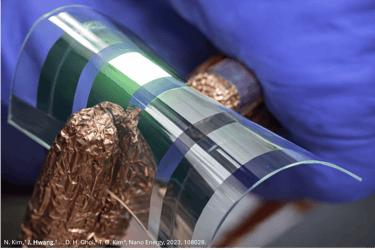
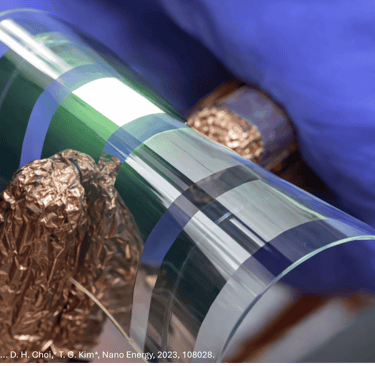
[17] Work-Function-Tunable Metal-Oxide Mesh Electrode and Novel Soluble Bipolar Host for High-Performance Solution-Processed Flexible TADF-OLED
N. Kim,† J. Hwang,† H. J. Lee, N. Y. Kwon, M. J. Cho, D. H. Choi,* T. G. Kim*
Nano Energy 2023, 108028.
[16] Deep Learning for Development of Organic Optoelectronic Devices: Efficient Prescreening of Hosts and Emitters in Deep-Blue Fluorescent OLED
M. Jeong,† J. F. Joung,† J. Hwang,† M. Han, C. W. Koh, D. H. Choi,* S. Park*
npj Comput. Mater. 2022, 8, 147.
[15] Aggregation-Induced Emission Luminogens for Organic Light-Emitting Diodes with a Single-Component Emitting Layer
J. Hwang,† P. Nagaraju,† M. J. Cho,* D. H. Choi*
Aggregate 2022, e199.
[14] Donor-Engineered Deep-Blue Emitters for Tuning Luminescence Mechanism in Solution-Processed OLEDs
J. Hwang,† H. Kang,† J.-E. Jeong, H. Y. Woo, M. J. Cho, S. Park,* D. H. Choi*
Chem. Eng. J. 2021, 416, 129185.
[13] Aryl-Annulated [3,2-a]Carbazole-Based Deep-Blue Soluble Emitters for High-Efficiency Solution-Processed TADF-OLEDs with CIEy < 0.1
J. Hwang, C. W. Koh, J. M. Ha, H. Y. Woo, S. Park,* M. J. Cho,* D. H. Choi*
ACS Appl. Mater. Interfaces 2021, 13, 61454.
[12] Novel V-Shaped Bipolar Host Materials for Solution-Processed Thermally Activated Delayed Fluorescence OLEDs
D. W. Lee,† J. Hwang,† H. J. Kim, H. Lee, J. M. Ha, H. Y. Woo, S. Park, M. J. Cho, D. H. Choi*
ACS Appl. Mater. Interfaces 2021, 13, 49076.
[11] High-Performance Solution-Processable TADF OLEDs via Adjustment of the Organoboron Acceptor Monomer Composition in Copolymer Hosts
M. Godumala,† J. Hwang,† H. Kang, J.-E. Jeong, A. K. Harit, M. J. Cho, H. Y. Woo, S. Park, D. H. Choi*
ACS Appl. Mater. Interfaces 2020, 12, 35300.
[10] Rational Design of Carbazole- and Carboline-Based Polymeric Host Materials for High-Efficiency Solution-Processed TADF OLEDs
J. Hwang, C. Lee, J.-E. Jeong, C. Y. Kim, H. Y. Woo, S. Park, M. J. Cho, D. H. Choi*
ACS Appl. Mater. Interfaces 2020, 12, 8485.
[9] Universal Polymeric Bipolar Hosts for Highly Efficient Solution-Processable Blue and Green TADF OLEDs
J. Hwang,† C. Y. Kim,† H. Kang, J.-E. Jeong, H. Y. Woo, M. J. Cho, S. Park, D. H. Choi*
J. Mater. Chem. C 2020, 8, 16048.
[8] Structural Isomers of 9-(Pyridin-2-yl)-9H-Carbazole for High-Efficiency Solution-Processed Green TADF OLEDs
J. Hwang, J. W. Yoon, C. Y. Kim, H. Kang, J. Y. Kim, D. W. Yoon, C. W. Han, S. Park, M. J. Cho, D. H. Choi*
Dyes Pigm. 2020, 179, 108403.
[7] Deep Learning Optical Spectroscopy Based on Experimental Database: Potential Applications to Molecular Design
J. F. Joung, M. Han, J. Hwang, M. Jeong, D. H. Choi, S. Park*
JACS Au 2021, 1, 427.
[6] Pyrazine-Based Hollow Spherical Self-Assemblies for Detection of Volatile Organic Amines
M. Kataria, J. Hwang, H. D. Chau, N. Y. Kwon, D. W. Lee, T. Kim, K. Lee, Y. Kim, S. Park, D. H. Choi*
Sens. Actuators B Chem. 2021, 343, 130110.
[5] New Hole-Transport Styrene Polymers Bearing π-Extended Conjugated Side-Chains for High-Performance Solution-Processable TADF OLEDs
J. H. Lee, J. Hwang, C. W. Kim, A. K. Harit, H. Y. Woo, H. J. Kim, Y. W. Kim, D. H. Choi, M. J. Cho, D. H. Choi*
Polym. Chem. 2021, 12, 1692.
[4] Complementary Absorbing Ternary Blend Containing Structural Isomeric Donor Polymers for PC61BM-Based Indoor Photovoltaics
H. D. Chau, N. Y. Kwon, S. H. Park, J. Hwang, M. Kataria, A. K. Harit, H. Y. Woo, M. J. Cho, D. H. Choi*
Polymer 2021, 221, 123606.
[3] Carbazole-Acridine-Based Hole Transport Polymer for Low Turn-On Voltage Green Quantum Dot LEDs
C. W. Kim, J. H. Lee, S. Cho, H. J. Kim, J. Hwang, Y. W. Kim, D. H. Choi, M. J. Cho, K. Lee, D. H. Choi*
Polym. Chem. 2021, 12, 4714.
[2] High Efficiency with Extremely Low Efficiency Roll-Off in Solution-Processed TADF OLEDs Using Xanthone-Based Bipolar Hosts
C. Y. Kim, C. Lee, H. J. Kim, J. Hwang, M. Godumala, J.-E. Jeong, H. Y. Woo, M. J. Cho, S. Park, D. H. Choi*
J. Mater. Chem. C 2020, 8, 6780.
[1] Photocrosslinkable Hole-Transporting Polymer for High-Performance Solution-Processed TADF OLEDs
J. H. Lee, C. H. Jeong, M. G., C. Y. Kim, H. J. Kim, J. Hwang, Y. W. Kim, D. H. Choi, M. J. Cho, D. H. Choi*
J. Mater. Chem. C 2020, 8, 4572.
If your are interested in joining the lab,
feel free to reach out to Jinhyo via E-Mail (jinyyyo@gmail.com)
Modern flexible electronics face major challenges due to the brittleness and rigidity of existing conductors. Overcoming these barriers is essential for making devices that can seamlessly interface with soft and dynamic environments. The long-term goal of my research program is to combine organic synthesis, polymer engineering, and soft material processing to build free-form optoelectronic systems that function reliably under deformation and complex geometries.